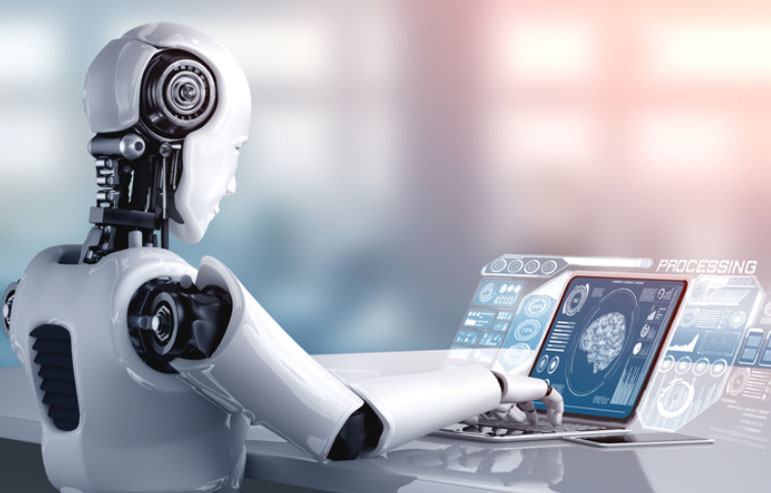
Artificial Intelligence (AI) and Machine Learning (ML) is set to bring about the next great revolution in Culture. We all remember how the iPhone changed the world in 2007. AI will do much the same, if not more, very soon.
We are already seeing more robots being built that can respond to and interact with human voice command. For the time being, don’t worry, robots are not going to replace humans. The more likely scenario however is that humans and robots will increasingly work side-by-side.
We’ve already heard how chatbots like ChatGPT and Google’s Bard will change our lives . . . And they will. However, AI technology still has a ways to go when it comes to applying itself to specific domains. Yes, industries will be turned upside-down, but not yet. This is because AI has a lot more to learn about itself. In other words, though AI is a reality now, its pervasiveness across all sectors might not be felt for another decade.
In ten years, we will look back and see how much AI has come to age. By then, specific fields will have been integrated with a developed AI, so much so that perhaps they will be unrecognizable. This won’t be true of all fields, but every niche will be impacted to a certain degree.
AI will not be without its inherent dangers and opportunities. There will be a learning curve for us all. We may not like these changes, but they have arrived. As with any new technology, parents/teachers will need to set boundaries of appropriate use for their kids/students. For example, it will be easy for a child to do a book report if all they have to do is ask their chatbot to come up with one. Instead, kids should be trained to do the hard work of reading a book and writing a report for themselves.
If we allow machines to do all the thinking for us, will we not fail to be human? Some will say, “The world has changed. Why should kids have to do work like this anymore?” I understand that sentiment, but I would say, “Because they’re human.”
We’re thinking things but we’ve also been made with the capacity to feel, touch, say, and do. Yes, robots can take over our jobs. But the question we need to think long and hard about is “Should they?” We need to answer this question before its everlasting too late. Because my fear is that if we don’t, there won’t be any turning back.




 We are very close to celebrating ten years! But ten years of what, you may ask? In 2007, entertainment-focused smartphones hit the market. I must confess that I was late to the game. As a teacher, I would see my students playing on the original iPhone while I was still pulling out my flip phone. Students were navigating the social media world on sites such as My Space and Facebook (which have been outdated for some time now). At the beginning of 2010, I finally gave in and did what I thought I would never do: join Facebook. But in 2011, I took an even bigger step: I bought my first smartphone. I can still hear the sound, “Droid.” I had the world at my fingertips and literally felt like I had stepped into a brave new world. I knew smartphones were a gamechanger when it came to “life as we know it.” However, the point I want to make is that I was and still am “old-school.” I want to stress that students were using smartphones and social media light years before I ever stepped into their world.