
Categories
Next Generation Ministry

Trophies of Grace

I am pictured on the bottom right

Other than the home, the church should be the primary place where formation and discipleship of the next generation take place. But discipleship need not be confined to the four walls of a church.

Within next generation ministry, there are so many places other than the church that one can serve. By way of example, I have worked with the next generation in public schools, private schools, and various organizations. Daycare’s, Boys and Girls Club of America, YMCA’s, Recreation Departments, Summer Camps, and Homeschool Associations are but a few of these “other” avenues.

The key is to find the age-group and venue you are passionate about. From there, you will need to take the necessary steps to get involved. So again, start with your passions. What is it that you like to do? What are your hobbies—Drama, Arts & Crafts, Music, Woodworking, etc.??

For me, it is coaching. I have coached recreation, travel, and school ball. The sports I enjoy coaching the most are basketball and soccer. I have coached at the middle school, jv, and varsity level.

Until this past week however, I had never won a championship. The Varsity Basketball team I am helping just won their third region championship in the past four years—and I got to be a part of it!

However, for the Christ-follower, winning a championship is not the end-game goal. This is because if you are a Christian, you’ve already been made a champion (Romans 8:37; 1 John 5:4).

But it’s also because your main aim in life is to make disciples (Matthew 28:19–20). You are a witness, a servant, a Christ-follower. As you follow Christ on the path he has set for you, your goal is simply to be an example for him wherever you go.

As you do this, He will be lifted up and He will draw all men (including the next generation) to Himself  (John 12:32). The trophy then won’t be something you can hold. It will be you—a trophy of his grace (Ephesians 2:4–10).

 

Categories
Next Generation Ministry

Conclave 2026–Go Dawgs!!

I am just getting back from Conclave Youth Conference held in Chattanooga, TN. I enjoyed encouraging and equipping student ministers with resources that can be found on this site. I ran into and prayed for youth leaders from GA, SC, NC, FL, AL, TN, KY, LA, MO, and IL.

Upon providing resources to these men and women, I prayed that God would start a disciple-making movement in their region that would branch out through their state and beyond.

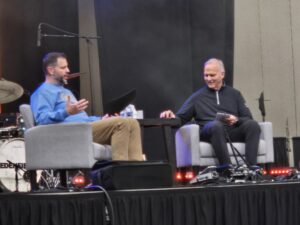
One of the highlights from the conference was hearing from keynote speaker Former Georgia Bulldogs Head Football Coach Mark Richt. Coach shared some stories about football but more importantly shared some stories about life.

He shared how Christians can overcome their fear with faith. He gave youth leaders lessons on leadership that related to humility, self-worth, and positive thinking.

Though sidelined with Parkinson’s Disease, Coach maintains a positive outlook on life by focusing on 2 Corinthians 4: 17: For our light and momentary troubles are achieving for us an eternal glory that far outweighs them all.

In fact, Scripture memorization was a key theme of the conference. I loved it because I know that memorizing Scripture plays a big role in discipleship. With AI sometimes distorting God’s Word, having the Word and holding it in our heart is vital.

I was also reminded at this conference that the next generation is the now generation. So many times, when the words next generation are used, people’s thoughts gravitate to thinking about the generation that is up and coming.

However this type of nomenclature can skew the meaning of the words. This is because we must remember that what God is wanting to do in the lives of the next generation is something he is wanting to do in THIS generation!

God continues to use the next generation in mighty ways to advance the gospel TODAY. He always has and He always will! ‘From the lips of children and infants you, Lord, have called forth your praise’ (Matthew 21:16b).

Categories
Jesus Next Generation Ministry

Will the real church please stand up?

Do you look at Covid-19 as a mountain or a molehill? Do you have faith the size of a mustard seed or do you have faith the size of an ocean. The second question is much more important than the first because if you have faith the size of molehill, then you will be able to move a mountain. The worst possible scenario would be for you to have no faith at all.

There’s no doubt Covid-19 has been disastrous for nations that have lost freedoms, churches that have lost members, and families that have lost individuals. However, if you stand back long enough, you might begin to see a bigger picture. And hopefully your students see your faith remain in a faithful God.

Covid-19 has been a disruption in all of our lives and not just an interruption. Two years into this disruption and we still do not know how long this disruption is going to last. I am sure there will be some effects that we will have to live for the rest of our lifetime. One thing we do know, however, is that many people who used to go to church and who we thought would come back have not. A general rule of thumb is 50% of church members do not attend the physical church service anymore and unfortunately, it appears a certain percentage of this number never will.

There used to be an old game show called To Tell The Truth where three people pretended to be a certain person. Panelists were allowed to ask all three people questions but eventually had to take a guess at which person was the real person. Panelists and the audience at home knew who the real person was when the real person was asked to stand up.

Using the nature of this gameshow, I want to suggest some good things that have come from Covid-19.

  1. Covid-19 has shaved off many nominal Christians from attending church. Now, that in fact is not good because we would like non-Christians and nominal Christians to attend church. However, if the church looks more like Jesus and less like the world, is that not good? A church that looks more like Jesus will be more attractive to a watching world.
  2. With the decline in attendance, some churches are struggling to stay alive. This again is not good. However, some of these churches had lost their way pre-covid and have now been forced to reach people for Jesus outside of their walls. These churches should have been doing evangelism all along.
  3. The process of persecution purifies, refines, strengthens, and often grows the church both numerically and spiritually. Persecution is not good in and of itself and certainly isn’t something that Christians should seek. However, persecution for the Christ-follower is unavoidable because Christ himself promised it would come to those who believe.

In short, what I am saying is that I believe the real church will not only survive these trying times, but will thrive. Only those churches that are alive and vibrant will remain. Churches that were dying pre-covid and that refuse to change post-covid will not last. Sure, some of their buildings will remain as some churches have more money than they know what to do with. But churches where worship and mission are dead will not attract the next generation. Their buildings will be empty. Kenda Dean has rightly noted that the next generation wants to be active agents of change rather than passive objects of ministry. David Setran says it may not be fair to ask why the next generation is leaving the church if they were never actually part of the church to begin with.

No matter how hard I try, I cannot get away from this quote by Ken Castor in the book Teaching Next Generations: “Older generations, by putting the needs and concerns of younger generations above their own, successfully encourage the next generations to follow Jesus and effectively empower them to lead in faith.” It’s not that the younger generation is more important than the older generation. It’s that the older generation keeps a church alive by releasing control and passing on the baton of faith.

Castor continues, “The question has often been posed: ‘Will the next generation follow in our steps?’ [That’s the wrong question]. Instead, the question should be reframed: ‘Will the next generation follow in the steps of Jesus?”

I couldn’t agree more. If the older generation didn’t follow in the steps of Jesus, why should the next generation follow suit. New wine is needed for new wineskins.

I once heard a story about an older lady in a church who went out of her way to sit with a younger lady during worship. The style of music was not the older lady’s preference but the older lady joyfully clapped and sang along because she was so happy that her younger counterpart was in church and was praising Jesus.

The answer to dead churches and dead people is and always has been Jesus. Jesus brings life! Andrew Root says the American church doesn’t have a lack of resources. It has a lack of life.

Praise Jesus! Worship Jesus! Go to the nations and make disciples for Jesus! Jesus is the Way, the Truth, and the Life.

Categories
Next Generation Ministry

Kindle Books now available

The world is “a changing.” Perhaps you remember the companies Kodak and Blockbuster. When I was a teenager, these companies dominated the camera/video industry. I would drive to Blockbuster, rent some videos or games for a weekend and then return them in time to avoid a fine. That is, until Netflix made Blockbuster obsolete. Who needed to go rent movies when the movies would come to you? And who needs Kodak when we can take out our phones and print our own pictures? Somehow, Kodak missed the digital era. What happened? These companies did not change with the times. They did not reinvent themselves.

In contrast, Disney World and Amazon have skyrocketed in sales since I was a teenager. What’s the difference? Why does Disney World have more people attending their theme park than ever before and why does Amazon continue to increase its sales? The reason: they continually tweak what they do best. And, they add the latest and greatest rides, attractions, or items to their agenda. It’s like coaching. Nick Saban, John Calipari, and Mike Krzyzewski are the best college coaches because they continually re-invent themselves and play to their strengths. Other coaches find themselves out of a job and looking from the outside-in.

Did you know that the next generation is changing the cheese industry? Kraft Foods is beginning to sweat. Our country’s cheese market is down 1.6 percent. Millennials are demanding “nourishment from ingredients that are both recognizable and pronounceable” (from a Bloomberg report). What’s the result? Todd Rhodes says, “McDonald’s, Wendy’s, and other fast-food restaurants are moving away from processed American cheese to offer things like Asiago and Real Cheddar.” If Kraft doesn’t readjust, they will be the next Kodak.

The church is no different. We live in difficult times. However, we the church still hold the message that can transform lives, heal families, and revive churches. It’s not our message that needs to change. It’s our methods. Reaching people today for Christ is not the same today as it was twenty-five years ago. We’ve gone from a country where everyone believed in God to a country where many doubt his existence. I won’t use this post to list all the areas the church needs to change. This post is written so the church will recognize it needs to change. I heard a great quote yesterday: “If you want to solve a problem, you must first admit you have a problem.” Church, we have a problem. We also have the solution!

Where do you need to change? That’s right—you? Change is hard. I know. As God disciplines us, it is often painful. But, I’m not talking about the change Christ brings about in us character over time. I’m saying where do you need to change so you can live like its 2018. I think part of the church’s problem is many churches are still doing church like it’s the 1950’s. “Doing church” is an even bigger problem, but I won’t go there.

For me, I resisted offering my next gen books in digital format. But, I realize the world is changing and I don’t want to get left behind. I want to like Coach K and Coach Saban be able to relate to the next generation even as I age. I don’t want to become like Kodak, a thing of the past. You can find my digital books in Kindle format on Amazon. My print books are cleaner in format and I would recommend you buy them. But, if reading books on your tablet, phone, or e-reader suits your fancy, be my guest! In fact, I updated Next Generation Ministry and Discipleship just a tad in the Kindle edition. The Kindle covers will appear different than the print covers. If you are interested in purchasing my books from the Kindle store, here are the links:

Next Generation Ministry and Discipleship

The M.A.P.’s Journal 

The Student Ministry Time Machine

Categories
Next Generation Ministry

New Book Release!

I am excited to inform you I have written another book! This book is primarily intended for youth pastors, student/family pastors, and next generation pastors. 

Come with me as I take student pastors and leaders on a ride through time to explore the history and future of student ministry! We will also look at where student ministry is today.

Trust me when I say this is an adventure you do not want to miss. 
Time-travel is quick! Hurry and jump in the student ministry time machine if you want to understand where professional student ministry has come from and where professional student ministry is going!

You can order your book from Amazon by clicking here.

Categories
Great Commission Next Generation Ministry

Exciting Announcement!

I am thrilled to announce the release of 2 new books!

In Next Generation Ministry and Discipleship, you will learn

-What next generation ministry is and how it differs from traditional children, youth, and family ministry.

-What a M.A.P. is and how it works.

-What a M.A.P.’s Journal is and how you can get it.

-What a Discipleship Group (D-group) is and how to have a meeting.

-How parents and leaders can disciple the next generation for real-life.

———————————————————————-

The M.A.P.’s Journal is designed for students to use in D-groups.

Currently, you may only purchase these books in print. Click on the title link to order from Amazon.

_______________________________

Students are returning to school now! Students are also returning to church. Leaders, as you launch your fall groups and studies, remember The M.A.P.’s Journal. This is the perfect resource for scripture memorization, spiritual development, and developing student leaders. I would have loved to offer M.A.P.’s for less than $9.99, but if I did, I wouldn’t be making anything. For those of you who don’t know, most authors don’t make much from their books. I have done M.A.P.’s as a service to you and not to make money. Look at it this way: D-groups are smaller than life groups, so you won’t have to order as many!

For those who are not familiar with the new model of student ministry called Next Generation Ministry, I would highly encourage you to buy Next Generation Ministry and Discipleship. Contrary to what many churches advertise on job boards, etc., next generation ministry is not the same as family ministry. And it is not your traditional children’s or youth ministry. Buying the book also brings you an extra benefit in that you will learn about practical discipleship, an area I think too many ministry leaders are ignoring. The M.A.P.’s Journal is also explained and only in Next Generation Ministry and Discipleship can D-group leaders get the Scripture passage that goes along with the M.A.P.’s weekly Scripture verse.

The M.A.P.’s Journal is the companion book to Next Generation Ministry and Discipleship.

I hope both books will benefit you and your ministry. Even more, I hope both books will benefit the Kingdom. Praise Jesus!

Categories
Next Generation Ministry

Ready, Get Set, GO!

My church recently took up prayer requests. A teacher (actually, me) raised his hand to offer a praise that school was about to end in 20 days! My praise was followed up by a prayer request from a grandmother that school was about to end in 20 days. Did you know that one out of five grandparents are taking care of either their grandchildren or adopted kids today? That’s the new reality. Either way, parents/guardians and grandparents all know that . . .

Summer is coming (which means students are returning home). What happened to the Spring?  I just flipped on the air conditioning! In the South, nothing beats the heat . . . and a nice cup of lemonade. Swimming pools, fishing holes, water parks, and lakes—give me anything with water, right! And don’t forget to turn on the fans! I know . . . It’s hot!

It’s hot, school’s out, and some things never change. The next generation will still be asking their parents/grandparents what they can do and if they can go to  ­­_________________.

Summer time is always a next generation minister’s busiest time of the year. But it is also a time where God often moves powerfully in the lives of students!

Vacation Bible School is still a great tool for reaching children for Christ! Many churches have stopped doing VBS and do their own outreach event or children’s camp. Last I heard, 25% of all church salvations happened at VBS. Statistics have proven youth who go to church camp often have stickier faith, meaning they are more likely to stay in church once they graduate. Students often use the summer to go on mission trips or conduct local mission projects. Backyard Bible studies and one-day summer events using a party trailer are also popular summer church events.

I always liked doing what I called the “1+1” philosophy of summer-time student ministry. Every week of the summer, I would offer a mission activity (nursing home, outreach, yardwork for the elderly, etc.) followed up in the following week by recreational/fun activity (movie, ice cream, ballgame or fun park). Only students who participated in the mission activity could participate in the fun activity. Why did I consider this approach to summer ministry important? Let me share a story with you . . .

Last week, I attended a summer camp informational meeting. I sat next to an older friend (old enough to be a grandpa) who shared with me that when he went to summer youth camp, he had to memorize 300 Bible verses before the camp would accept him. He would literally spend all year memorizing Scripture so he could go to camp. The flip side of this account is that the camp was free. It’s the opposite today. Today, you don’t have to memorize any Scripture, but if you have $300, any camp will take you. We’ve gone from 300 verses to $300. Which camper do you think grew more spiritually? It might not always ring true, but I would say nine out of ten times, it’s the camper with more buy-in.

These students learn life lessons and tend to appreciate the overall experience more. Many students today work church fundraisers so they can afford to go to summer camp. It’s the same principle. I know many churches do not believe in fundraisers and that’s ok. The question I would ask your church is, “what are you doing to prepare your students spiritually for camp?” It’s important you take time to spiritually prepare students for camps/mission trips, but I think it’s equally important that you take time to reflect on what happened once you get back to church from camp.

Camps and mission trips are learning experiences. The more time you spend preparing your students for the impact to come and the more time you spend with students evaluating the impact that happened, the better. In other words, what now? How are you going capitalize at church and in your local community with the transformation that just took place in the lives of your students? Students need to have a plan, but better yet, they need to be the ones to come up with the plan. Next generation pastors, Set your summer events up, Go, and Then break them down! Not only will your students grow from the experience, your mindset on summer ministry will have likely changed forever!

Categories
Next Generation Ministry

What is working?

Next generation ministry is all about parents, leaders, and students. It’s also about the local church, God, and reaching the community. So much ink has been spilt over the numbers, percentages, and statistics of the the next generation straying or leaving their church or their faith.

Granted, this is a problem. But, in looking for a solution, one must first start with the question, “What is currently working?” Recently, my watch stopped working. Now, I don’t wear watches all that often, but I do on occasion. There was nothing wrong with the band, case, dial, crown, or lugs. All the watch needed was a new battery. So, after a trip to the watch store and spending $10, my watch was up and running again.

Steve Parr recently wrote a book entitled, Why They Stay: Helping Parents and Church Leaders Make Investments That Keep Children and Teens Connected to the Church for a Lifetime. The book is filled with practical advice, but above all, the books tells the church what is working! Steve identifies fifteen items:

  1. Young adult repented and believed in Jesus as a child or teen
  2. Young adult was baptized as a child or teen
  3. Young adult had good relationships with both parents while being raised
  4. Young adult was not a strong-willed child. *Note: Steve clearly notes that strong-willed children can and do stay in the church, but that extra guidance needs to be given to parents with children that have this temperament.
  5. Parents were balanced in their disciplinary style. *Note: think instruction/correction instead of punishment/control.
  6. Parents stayed together. *Note: It was much harder for teens to stay in church as a young adult than students who experienced divorce as a child.
  7. Parents/students were not separated during the worship service.
  8. Pastor was liked by children and teens.
  9. Church had a strategic student ministry with a schedule of activities.
  10. Parents actively served in the church as opposed to just attending.
  11. Church had a ministry geared toward college-aged young adults.
  12. Young adults attended college and graduated. *Note: This stat is not meant to discriminate against those who did not go to college. It’s just what the research revealed.
  13. Church helped college-aged young adults connect to a local church and campus ministry whether the student stayed at home or not during his or her college-aged years.
  14. Students held a high view of Scripture.
  15. Students had made a personal commitment to stay in church and their faith became rooted in a personal experience with Jesus Christ.

See, there is a lot that is working! Don’t throw in the towel just yet. Being a Christ-follower is not for the faint of heart. Wimps and quitters need not apply. When the going gets tough, the tough gets going. You are living in perilous times, but God has promised to be with you in this challenging task to reach the next generation!

Jana Magruder also recently wrote a book describing what parents can do the influence the long-term spiritual condition of their kids. Jana’s book, Nothing Less: Engaging Kids in a Lifetime of Faith goes right along the lines of Steve’s book. Jana lists these nine positive influencers of parents:

  1. Parents participated in missions trip as a family as their kids were growing up.
  2. Parents participated in ministry or service projects with their kids as they were growing up.
  3. Parents frequently shared Christ with unbelievers as their kids were growing up.
  4. Parents personally read the Bible several times a week or more as their kids were growing up.
  5. Parents encouraged teen children to serve in the church.
  6. Parents typically asked forgiveness when they messed up as their children were growing up.
  7. Parents encouraged their children’s own unique talents and interests as they grew up.
  8. Parents attended churches that emphasized what the Bible says as their kids were growing up.
  9. Parents taught their children to tithe as their kids were growing up.

Dear parents and leaders, you can accomplish the task of seeing the next generation come to faith in Christ while staying committed to both Jesus and his church! I know because it has been done before! There’s nothing wrong with looking for new methods to accomplish the same task. Just don’t forget to use what has worked in the past.

Or maybe, you just needed your battery re-charged!

Categories
Next Generation Ministry

Fill the Slate!

Barna Research recently conducted a webcast on Gen Z. I want to use this post to share some of Barna’s findings on the largest study done on Gen Z as of date. I also want to include some general highlights or comments about Gen Z that stood out to me as I watched.

Four descriptors of Gen Z are that they are career-oriented, they are screenagers, they are extremely diverse, and their context is post-Christian. Spiritually, they are blank-slates with a third being either atheist, agnostic, or a none (non-churched). Only 4% had a biblical worldview and 12% described their sexuality as non-heterosexual. 33% said gender is how they feel, not their birth sex. 66% didn’t think lying was wrong. 57% use screen media four or more hours a day.

43% said educational achievement was very important to having a strong sense of self. Surprising, this ranked above family/religion (34%). Even more surprising was that 37% identified gender as very important to their sense of self and 29% of Gen Z said they knew someone who had changed their gender identity.

Only 20% wanted to be married by the age of 30 and only 12% wanted to be a parent before the age of 30. Thirty-eight percent just wanted to enjoy life in their 20’s. What Gen Z did want to accomplish before age 30 was finishing education/starting a career (66%) and becoming financially independent (65%). In fact, Gen Z sees financial independence as the primary mark of adulthood, not emotional maturity (as their predecessors, the Millennials did).

51% of Gen Z claimed happiness as their ultimate goal and 43% of these defined happiness in terms of financial success.

The data means next generation leaders need to help the next generation wade through their doubt (science/evolution was causing this generation trouble in their beliefs as they claimed to believe in facts, but not truth), offer more challenge/training (less safety/entertainment for a bubble-wrapped population segment), assist in developing relational (social media is making people less social) and decision-making skills (answers not found on google caused Gen Z confusion/anxiety), while providing vocational discipleship as well as discipleship in terms of gender issues.

A summation of individual responses from Gen Z on why it was hard to live for Christ in today’s world included (1) I feel all alone, (2) I don’t feel I can answer everyone’s questions about my faith, (3) I don’t want to be viewed as an extremist, (4) There are so many distractions, (5) Culture says we are intolerant or judgmental, and (6) It’s hard to defend my faith when challenged.

Thus, next generation leaders need to provide Gen Z with reasons for their faith (truth is not relative and there are consequences for not following truth), emphasize relationships (God is not an abstract idea, but a real person who wants a relationship with you), and provide rhythms where Gen Z can practice their faith (“We believe what we repeatedly do”).

Gen Z was found lacking a moral compass or sense of true north. In a society where a strong opinion can be seen as offensive, Gen Z was often afraid to challenge and afraid to share. Gen Z is extremely sensitive to certain topics and was often found saying, “I don’t know,” “not sure,” or “I’m so confused.” In college, students are often given trigger warnings before hearing about sensitive topics and allowed to leave the room if compelled to do so.

Gen Z often compared themselves to others and FOMO is real. Social medial became their arbiter of happiness and served to remind them that they themselves were not happy. Next generation leaders should teach that happiness is not end-all, be-all in life.

I hope this inside look will help you understand Gen Z so you minister more effectively to them!

Categories
Next Generation Ministry

Gaming or God?

In the above picture, you can see what is called the Alienware Area 51. Boy, gaming sure has come a long way than when I used to play! I still don’t mind playing the occasional sports game, but when I was a teenager, gaming was bigger than life. Sure, I was active outdoors and in the neighborhood, went to school and church, but I, like many of my friends, lived to game!

I understand this generation’s fascination with gaming. Barna recently reported that over sixty percent of teenagers stated that the number one reason teens used their phones was to play games. But when I was growing up, we didn’t have smart phones and we sure didn’t have games on our phones.

The neighborhood boys would take turns going to each other’s house to play video games. This way, we could play the game systems we didn’t own and have friendly competition between each other. There was no XBOX Live, where you could play with your best friends online without having to leave the comfy combines of home.

AOL was kicking into high gear about this time so my friends and I began to get involved more with computer gaming. We still went to each other’s house, but this time, we piled the chairs around the computer screen. I can still remember when the Gateway 2000 computer arrived at my family’s home in what looked like a “dairy cow” box.

My favorite game of choice was a strategy game called Civilization. In this role-play game, you picked a nation and its represented leader to try to take over the world. I played the game every chance I got and for hours on end.

I even remember the old magazine Nintendo Power and how the back of the magazine advertised the “Triple Play.” Yep, I had to do it, so at one time I owned the NES, Super NES, and Game Boy.

Games today are much more violent and grotesque than when I used to play. You used to have to have to enter a code to get blood to show up on the screen, and even then, it looked like grey sweat. Stores back in my day wouldn’t have been caught dead selling a game like Grand Theft Auto where you could steal cars and run over cops.

To show you where my game IQ is now, I walked into Best Buy last week and asked where their computer games were. The salesman pointed to me what little they had to offer. The reason they didn’t have much was because everyone downloads their games now. Then I went over to the system console section to see what games they had to offer. Needless to say, I walked away highly depressed. I couldn’t find anything that would suit my fancy.

Games bring a certain healing and destructive power with them. Games are fun and rewarding. Who doesn’t like to beat a hard level, a big boss man, or the game itself? But games can also be addictive, steal one’s life away, and keep people in a fantasy land where they never have to grow up and become responsible adults.

As I said earlier, I understand gamers because I was one. I don’t like to bash the gaming culture, but I do like to give gamers a glimpse of reality that some seem to be missing. The choice really becomes one of two questions. Are playing games your God? Or is God your God? If games are your God, then God is just a game. If God is your God, then a game is just a game. The words of Joshua come to mind: Choose this day whom you will serve . . . But for me and my house, we will serve the Lord (Joshua 24:15).

Some games are appropriate. Others are not. Don’t overplay and don’t get overplayed. And my last bit of advice when it comes to gaming: Play hard, but pray harder. Seek first the Kingdom of God and all these things shall be added unto you (Mat 6:33).